
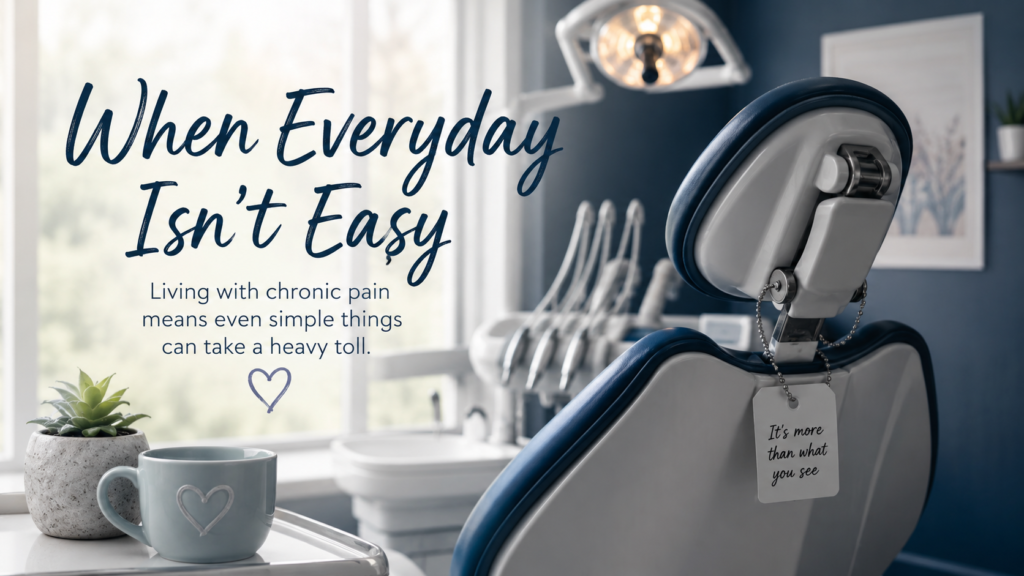
Yesterday, I had a routine dental check-up.
Nothing major. No fillings. No root canal treatment. Just a check-up, routine x-ray and a scale and polish. Good news – my teeth are fine.
If you’d asked the dentist how the appointment went, they would probably have said it was straightforward / uneventful. Everything looked fine, and I was on my way within half an hour.
If you’d asked me, though, you’d have got a very different answer.
Like so many things when you live with chronic pain, what should have been an ordinary appointment became something that affected the rest of my day.
That’s one of the hardest things to explain to people who don’t live with chronic pain. Everyday life isn’t really everyday anymore.
Every little task has consequences.
As I sat in the waiting room, I already knew I’d probably pay for the appointment later. Experience has taught me that. It isn’t anxiety about visiting the dentist. They’re always kind, patient and understanding. It’s simply knowing how my body reacts to even the smallest everyday challenges.
When I was called through, I climbed into the chair and tried to relax. The examination itself wasn’t too bad, but then came the ultrasonic cleaning.
Keeping my mouth open sounds so simple. Most people never even think about it.
After a minute or two, my jaw started to ache. Holding it open became harder and harder. The muscles felt like they’d run a marathon. I found myself desperately wanting to close my mouth for just a few seconds, but every time I did, I knew we’d only be delaying the inevitable.
Then the ultrasonic cleaner started.
I know lots of people don’t particularly enjoy it, but for me it was genuinely painful. Every vibration seemed to travel through my jaw and into the sides of my face. My teeth became incredibly sensitive, and my whole jaw began to tense.
I wasn’t scared. I wasn’t being dramatic. It simply hurt.
By the time I left the chair, the pain had spread. My jaw was throbbing, the pain felt like I’d been chewing hard toffee for ages. I’d developed a headache that wrapped itself around the side of my temples, and my neck and shoulders felt as though someone had tightened every muscle with a spanner.
Lying still in the dentist’s chair for twenty or thirty minutes had been enough to set everything off.
Someone else would probably have gone shopping afterwards. Or back to work. Or met a friend for lunch.
I went home.
Not because I wanted to, but because I needed to.
The headache was getting worse, my jaw hurt every time I spoke, and my shoulders were stiff enough to make the short drive home uncomfortable.
That one simple appointment had used up everything I had for the day.
That’s chronic pain.
It’s never just one thing.
The Domino Effect
One area hurts, and before long something else joins in.
- Jaw pain becomes a headache.
- The headache makes your neck tighten.
- The tight neck pulls on your shoulders.
- The shoulder pain changes how you sit.
- Sitting differently makes your back ache.
- Poor sleep that night makes tomorrow even harder.
It’s like watching dominoes fall. Once the first one tips over, it’s difficult to stop the rest.
People sometimes wonder why one small activity can leave us feeling completely exhausted.
The answer is that our bodies aren’t reacting to one thing. They’re reacting to dozens of things all happening together. The pain cascade.
It’s Never Just the Dentist
The dentist is only one example.
Having a haircut can leave my neck aching for hours because of the position I have to sit and hold.
Standing in a queue at the supermarket can be harder than walking around the shop.
Sitting through a meal out can mean shifting position every few minutes while hoping nobody notices.
Carrying a couple of shopping bags from the car might mean I can’t lift my arms comfortably later that evening.
Even something as simple as changing the bedding can leave me needing to sit down halfway through.
These aren’t difficult jobs. At least they shouldn’t be.
But chronic pain doesn’t understand the difference between climbing a mountain and carrying some shopping.
To my body, they’re simply challenges that require energy I often don’t have.
Everyone’s Version is Different
One thing I’ve learned through Thrive Cheshire is that no two people experience chronic pain in exactly the same way.
Some people can walk for miles but can’t sit for more than ten minutes.
Others can sit comfortably but struggle to stand.
Some live with constant burning nerve pain.
Others battle aching joints or muscles that never seem to relax.
Many of us are dealing with several different conditions all at once. What wipes me out might not affect someone else at all. Likewise, something I manage quite well could leave another person needing several days to recover.
That’s why it’s never helpful to compare pain. There isn’t a league table. Nobody wins by hurting more. Our journeys are different because our bodies are different.
The Things Nobody Sees
When people see me out and about, they usually see a smile. What they don’t see is everything that happened beforehand.
- They don’t see me wondering whether today is a good enough day to go out.
- They don’t see the medication I’ve already taken or what I might need later.
- They don’t see me stretching before I leave the house.
- They don’t see me checking whether there’ll be somewhere to sit.
- They don’t see me thinking about how far I’ll have to walk from the car.
Most of all, they don’t see me wondering whether, whatever I’m about to do will be worth the recovery time afterwards. Those calculations become automatic.
They’re running quietly in the background all day long.
Pacing Isn’t Giving Up
One of the biggest lessons chronic pain has taught me is that pacing isn’t weakness. For years I fought against it. I’d push through because I didn’t want pain to win. Sometimes I still do. The trouble is, pain usually has the final say.
Now I try to work with my body instead of against it.
If I know I have a hospital appointment tomorrow, I won’t fill today with jobs.
If I’ve arranged to meet friends, I’ll probably make sure the day before is fairly quiet.
If I’ve had a particularly difficult morning, I’ll accept that the afternoon may need to be spent resting.
It’s frustrating. I don’t like it.
But fighting my body every single day only leaves me feeling worse.
The Emotional Side
There’s another part of chronic pain that people rarely talk about. Grief.
Not the kind that follows losing a loved one, but the quiet grief of losing the life you once had.
- I miss doing things without planning them.
- I miss saying yes without checking my diary for recovery days.
- I miss going somewhere without wondering where the nearest chair is.
- I miss thinking about what I’d like to do instead of what I might be able to do.
Those losses are real. It’s okay to acknowledge them. Doing so doesn’t mean we’ve given up. It simply means we’re being honest.
Kindness Makes a Difference
Living with chronic pain has also taught me something positive. Kindness matters.
- The friend who slows their walking pace without making a fuss.
- The receptionist who finds a chair while you’re waiting.
- The family member who quietly carries the shopping.
- The dentist who gives you a chance to rest your jaw halfway through the appointment.
Small acts of understanding can completely change someone’s day.
They remind us that we don’t always have to explain ourselves. Sometimes being believed is enough.
Looking Beyond What You Can See
Chronic pain is often called an invisible illness because, for many of us, there are no obvious signs.
People see us walking into a cafe and assume we’re fine.
They don’t see the heating pad waiting at home.
They don’t see the afternoon we’ll spend recovering.
They don’t see the sleepless night that might follow.
Invisible doesn’t mean insignificant.
It simply means the struggle happens where other people can’t see it.
Everyday Isn’t Easy
That trip to the dentist reminded me of something I already knew, but sometimes need reminding of.
Living with chronic pain means there really is no such thing as an ordinary day.
An appointment that most people would forget about before lunchtime became the main event of my day. Not because anything went wrong, and not because anyone did anything wrong, but because my body reacted in the only way it knows how.
Tomorrow it might be vacuuming the house. Next week it could be sitting through a meeting.
The week after that it might be something as simple as carrying the shopping indoors.
To someone else, they’re everyday jobs. To me, they can be genuine challenges.
If you’re reading this and recognising yourself, please know that you’re not alone.
- You aren’t lazy because you need to rest after doing something that looks simple.
- You aren’t weak because you have to pace yourself.
- You aren’t exaggerating because your body reacts differently to someone else’s.
Living with chronic pain means adapting to a world that often expects everyone to function in the same way. We know that isn’t reality. Some days we achieve everything we’d planned. Some days we only manage one thing.
Both are enough.
Sometimes getting through the day is an achievement in itself, and that’s something we should never underestimate.
So, the next time someone tells you, “It’s only a dentist appointment,” smile if you can.
Because those of us living with chronic pain know the truth. Sometimes the smallest things ask the most of us.