
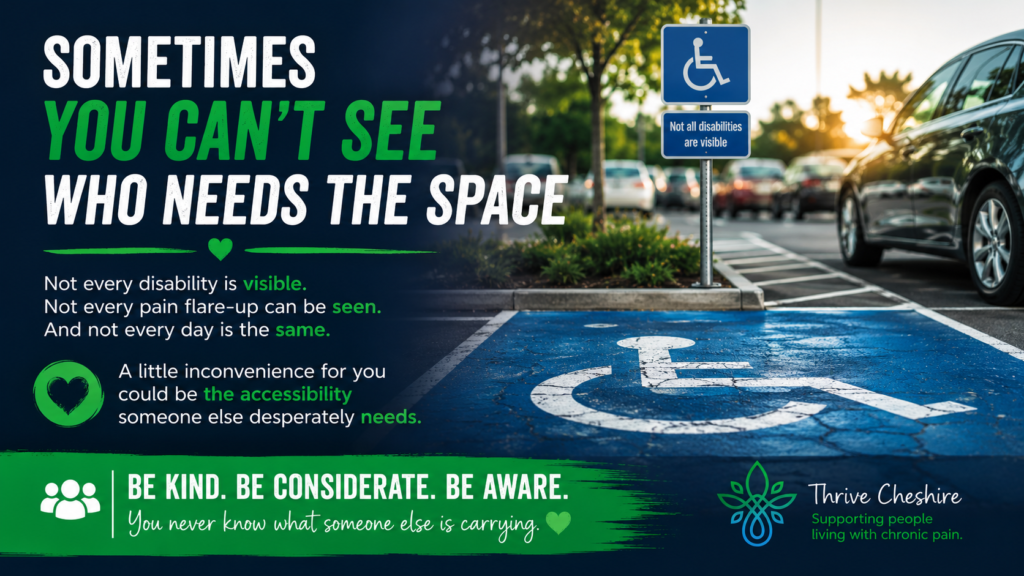
Sometimes You Can’t See Who Needs the Space
I came across a story recently about a disabled parking space and the arguments that followed when people without Blue Badges tried to use it.
At first, it might seem like a story about parking. But the more I thought about it, the more I realised that it is really about something much bigger.
It is about accessibility, entitlement, inconvenience and the assumptions we make about other people.
The story described a customer who arrived at a shop in a wheelchair, only to find that someone without a Blue Badge had parked in the disabled space.
He had to park in another car park and make his way to the shop from there. Understandably, he was angry.
That parking space existed for people who might not be able to manage the extra distance, the uneven ground, the additional time or simply the physical effort involved in getting from somewhere else.
For one person, parking further away might be an irritation.
For another, it might mean they cannot make the journey at all.
And that distinction matters so much.
But there is another side to this
For people living with chronic pain or other invisible conditions, accessibility can be incredibly complicated.
You cannot always look at somebody and know what they are dealing with.
- They may be able to walk.
- They may not use a wheelchair.
- They may not use a stick every day.
- They may even look (to you – with an untrained eye) completely healthy.
And yet walking another 100 metres across a car park might leave them in severe pain for the rest of the day.
They may have carefully planned their day around the amount of walking they can manage.
They may be having a particularly bad pain day.
They may have a condition that fluctuates, meaning they can walk reasonably well one day and struggle terribly the next.
You simply cannot always see disability or chronic illness
That is one of the hardest things about living with an invisible condition.
People often judge what they can see rather than what they cannot.
I’m only going to be a minute
The original story included some familiar excuses:
- “There’s nowhere else to park.”
- “Nobody is using it.”
- “I’ll only be a few minutes.”
- And perhaps the most telling: “Why should I have to walk further?”
But sometimes the answer is simply that we all must accept a little inconvenience for the sake of somebody else.
- You might have to park further away.
- You might have to wait.
- You might have to walk around.
- You might have to give somebody else the space, seat or access they need.
- That isn’t necessarily unfair.
Sometimes it is simply what living alongside other people requires. We do not live alone on this planet.
And when it comes to accessibility, the inconvenience isn’t necessarily equal.
Walking an extra distance might be mildly annoying for one person.
For somebody living with chronic pain, it could mean increased pain, exhaustion, medication, a flare-up or having to abandon whatever they had planned to do.
Those two experiences aren’t necessarily comparable.
And perhaps that’s the bigger lesson
We have become very used to asking:
- “It’s not my fault that they are disabled”
- “What about me?”
- What about my convenience?
- What about my plans?
- What about the fact that I’m in a hurry?
- What about the fact that there isn’t anywhere else to park?
But perhaps sometimes we should stop and ask a different question:
“What if the other person needs this more than I do?”
We don’t always know what somebody else is dealing with.
The person who looks perfectly healthy may be living with severe chronic pain.
The person who appears to be walking normally may just be having one of their better days.
The person who doesn’t look disabled may have spent years adapting their life around an illness that other people cannot see.
And that’s why we should be careful about making assumptions.
It isn’t about being entitled
Having a disability, chronic illness or accessibility need isn’t about getting special treatment.
It is about removing barriers that able bodied people don’t have to deal with.
- A disabled parking space isn’t a reward.
- An accessible toilet isn’t a luxury.
- A priority seat isn’t a perk.
Reasonable adjustments aren’t about making somebody else’s life more important.
They exist because people don’t all start from the same place.
And perhaps that’s something worth remembering when we become frustrated by an accommodation that doesn’t appear to benefit us.
- We don’t necessarily know who needs it.
- We don’t necessarily know why they need it.
- And, importantly, we don’t need to know.
- We can simply choose to respect it and accept it.
Because sometimes the thing that feels like an inconvenience to us is the thing that allows somebody else to participate in ordinary life. And surely that’s worth a little inconvenience.
So, the next time you’re tempted to think:
- “It’s only a parking space.”
- “It’s only a few extra steps.”
- “They don’t look disabled.”
- “What’s the big deal?”
Maybe just pause for a moment.
You don’t know what somebody else is carrying.
And sometimes the most considerate thing we can do is accept that something wasn’t designed for our convenience. It was designed to make somebody else’s life a little bit more possible.