
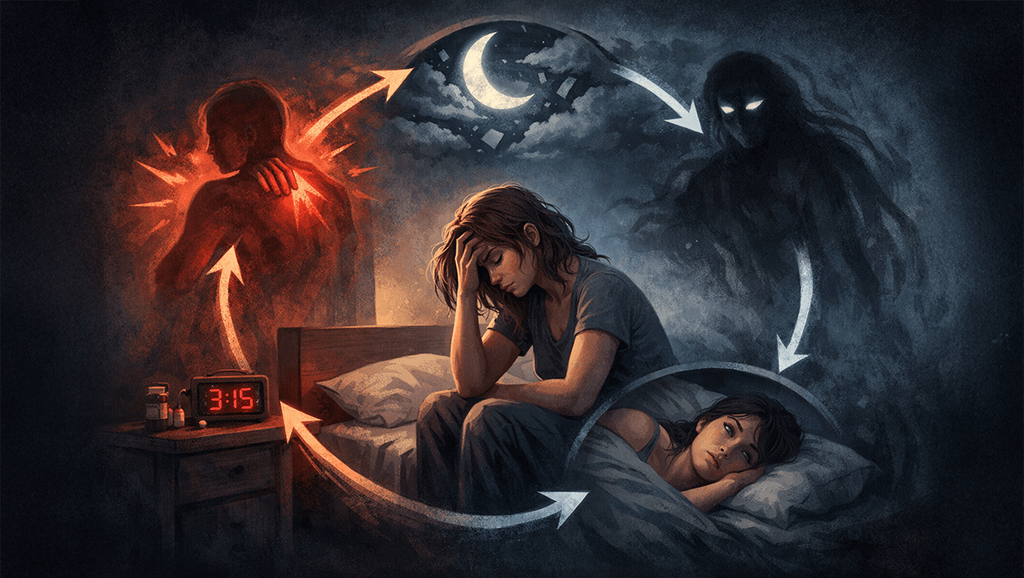
Living with chronic pain means living inside a system that never really powers down. Pain isn’t just something I experience during the day and then leave behind at night. It follows me into bed, settles beside me, and makes itself known the moment I try to rest. Sleep, which is supposed to repair and restore, becomes another battleground. I don’t simply go to bed and fall in a beautiful asleep. I negotiate, I brace, I wait, and so often I lose.
Pain has its own rhythm at night. When the world goes quiet, it feels louder. Without distractions, every ache sharpens. Every nerve seems more alert. I shift positions constantly, chasing a moment of comfort that never lasts. Sometimes it’s the pain itself that keeps me awake. Other times it’s the anticipation of it. I know that if I move the wrong way, I’ll pay for it. That kind of vigilance doesn’t allow deep, restorative sleep. It allows light, broken fragments at best; and the battle repeats itself throughout the night.
When sleep is poor, the consequences show up fast. I wake early, feeling like I’ve never really rested. My body feels heavy and brittle, like it’s already used up its energy before the day has even started. Exhaustion seeps into everything. Tasks that once felt manageable now feel oversized and daunting. Walking downstairs, putting my socks on, making breakfast, answering messages, all require so much more effort than they should. I’m not just tired. I’m depleted and full of fatigue.
The exhaustion affects how my brain works. Brain fog rolls in and refuses to lift. Words go missing mid-sentence. Thoughts feel slow and disorganised. I struggle to concentrate, to remember basic things, to follow simple conversations. My attention span reduces. It can feel embarrassing and frustrating, especially when people assume tiredness is something a strong coffee should just fix. This isn’t that kind of tired. This is the kind that lives deep in the bones and affects everything you try to do.
Poor sleep doesn’t just follow pain. It feeds it. When I’m exhausted, my pain threshold drops. Sensations that might have been tolerable on a better-rested day become overwhelming. My muscles tense more easily. My nerves seem more reactive. It’s like my body loses its ability to buffer my regular discomfort. Pain becomes sharper, louder, harder to ignore. And so, the vicious circle strengthens.
Mood is often the next thing to suffer. When pain and exhaustion stack up, my emotional resilience wears thin. Small setbacks feel bigger. Irritation comes quicker. Sadness lingers longer. I don’t wake up one day and suddenly feel depressed. It creeps in gradually, fuelled by sleepless nights and relentless discomfort. It’s the accumulation of everything that does it.
Depression, for me, doesn’t always look like constant sadness. Sometimes it looks like numbness. A flattening of emotion. Things I used to enjoy feel distant or irrelevant. Motivation slips away quietly. The energy required to care about the future feels out of reach when I’m just trying to survive the present. Chronic pain narrows the world, and depression tightens it still further.
Sleep deprivation makes it harder to push back against those thoughts. When I’m tired, my mind is less able to challenge the negative narratives that pain brings with it. I start believing the worst versions of my own thoughts. That this is all I’ll ever be. That I’m a burden. That improvement is unlikely. These thoughts feel more convincing at three o’clock in the morning, lying awake, than they ever do in daylight.
The cruel part of this vicious circle is how self-reinforcing it is. Pain disrupts sleep. Poor sleep worsens pain. Both erode mood and mental health. Depression then makes sleep even harder to come by. Anxiety about another bad night creeps in as soon as evening arrives. I start monitoring my body, my energy levels, the clock. The bed becomes associated with struggle rather than rest.
There’s also grief woven into this cycle. Grief for the kind of sleep I used to have, the effortless kind. Grief for the version of myself that could bounce back from a bad night without consequences. Chronic pain forces a reckoning with limitations, and sleep loss makes those limitations impossible to ignore. It’s hard not to mourn the ease of life that’s been lost.
Over time, this constant strain affects how I see myself. I can start measuring my worth by productivity, by how much I manage to do despite everything. On bad days, when pain is high and sleep has been scarce, that measure collapses. I feel like I’ve failed, even though the circumstances were never under my control. Depression feeds on that sense of utter inadequacy.
What helps, at least a little, is understanding that this cycle isn’t a personal flaw. It’s a physiological and psychological response to long-term stress on my body and mind. Chronic pain has changed my nervous system. Sleep deprivation has changed how my brain regulates emotion. Depression is not weakness; it’s a predictable outcome of being under constant pressure without any relief.
Naming the circle gives me a small amount of power. When I notice my mood dipping after several bad nights, I try to remind myself why. When my pain feels unbearable after poor sleep, I can sometimes see the connection, instead of blaming myself for not coping with it better. That awareness doesn’t fix the problem, but it can soften the self-judgment that often comes with it.
There are moments of kindness I try to offer myself within this endless loop. Adjusting expectations on low-sleep days. Allowing rest and afternoon naps without having guilt. Accepting that some days are about getting through, not pushing forward. These aren’t solutions, but they are survival tools.
Living with chronic pain means living with this vicious circle, but it also means learning to navigate it with as much compassion as possible. Pain, sleep, and depression are tightly linked, and when one spirals, the others often follow suit. Recognising that connection doesn’t make the nights any easier, but it reminds me that I’m not broken. I’m responding to something that is genuinely hard.
Some days, that understanding is just enough to keep me going.