Living with chronic pain means I measure days differently. Not by what I achieve, but by what I manage. So, when our chronic pain support group, Thrive Cheshire, planned a day trip to Liverpool to visit the Titanic Exhibition at the White Star Line Hotel, I felt that familiar mix of excitement and nerves. A day out is never just a day out for us. It’s planning, pacing, medication timing, backup plans, and a quiet hope that our bodies will cooperate.
Still, we went.
We met at Winsford station in the morning. There’s something grounding about starting a journey together. Some of us use walking sticks. Some rely on mobility aids. Some carry invisible pain that doesn’t show at all. But we all understand each other in a way that doesn’t need much explaining. That alone makes the effort worthwhile.
The train from Winsford to Liverpool felt like the official beginning of the adventure. I always try to grab a seat quickly, not out of impatience but self-preservation. Standing for even a short stretch can set off a chain reaction in my back, neck, shoulder and hip. Once seated, though, I could relax a little. We chatted, shared snacks, compared how we were feeling that morning. There’s comfort in that honesty. No one pretends they’re fine when they’re not.
Arriving in Liverpool brought the usual rush of movement and noise. Train stations can be overwhelming on a good day. On a high-pain day, they feel like obstacle courses. We caught taxis to the White Star Line Hotel, which took the pressure off navigating unfamiliar streets on foot. That small decision made a big difference. It meant we arrived with energy still in reserve instead of already running on empty.
The hotel itself felt steeped in history. There’s something surreal about stepping into a place connected to such a monumental story. The Titanic isn’t just a ship; it’s become shorthand for ambition, tragedy, and human vulnerability. Visiting an exhibition about it carries a certain weight.
What stood out immediately, though, wasn’t the history. It was the accessibility.
For those of us with restricted access needs, the museum staff were calm, helpful, and prepared. There was a ramp to enter, and a lift to reach the exhibition space. No awkward shuffling, no long detours, no feeling like an inconvenience. Just quiet practicality. You don’t realise how rare that can be until you’ve experienced the opposite.
Even better, the entire exhibition was laid out on one floor. That mattered more than we can put into words. Stairs can turn an interesting day into a painful ordeal. Multiple floors mean constant calculations: Can I manage this? Will I pay for it later? Having everything on one level allowed us to focus on the story in front of us instead of the strain in our joints.
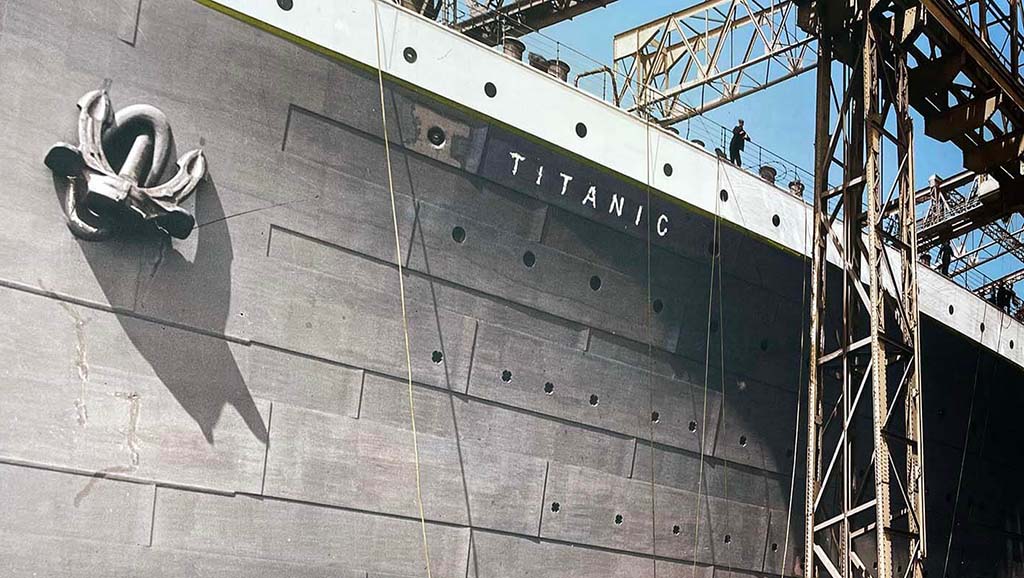
The exhibition itself was immersive and thoughtful. Photographs, artefacts, personal stories. I found myself drawn to the ordinary details. Letters home. Menus. Cabin layouts. It’s easy to think of the Titanic as a headline, but walking through those displays reminded me it was made up of individual lives, each one carrying hopes, plans, everyday worries. One artefact struck me more than any other. A single teacup brought from the actual wreck, 12,500 feet underwater, displayed in front of a restored photograph of the very tearoom, taken before the voyage, where it sat on its matching saucer.
In a strange way, it all resonated with me. Chronic pain has a way of shrinking your world. Big ambitions get replaced with smaller, more immediate goals: get through today, manage this flare, make it to that appointment. Standing there, reading about people who boarded a ship believing in a certain future, I felt a quiet reflection on how unpredictable life can be. Not in a dramatic way. Just in the sense that none of us really know what’s coming next.
There were moments when I had to sit down. That’s part of my rhythm now. Do a little, rest a little. I’ve learned that pushing through rarely pays off. The beauty of being there with Thrive Cheshire was that no one questioned it. Someone would sit with me. Someone else would carry on and then come back to share what they’d seen. We moved at the pace of the slowest body in the room, and no one complained.
After we’d explored the exhibition, we made our way up to the rooftop café for a drink. That felt like a reward. The view over Liverpool was lovely, but more than that, it was a moment to pause. Hot drinks in hand, we talked about what had surprised us, what had moved us, what had stuck.
There’s a particular kind of laughter that happens when people who understand pain get together. It’s not forced positivity. It’s not denial. It’s the kind that says, We’re still here. We still get to do this.
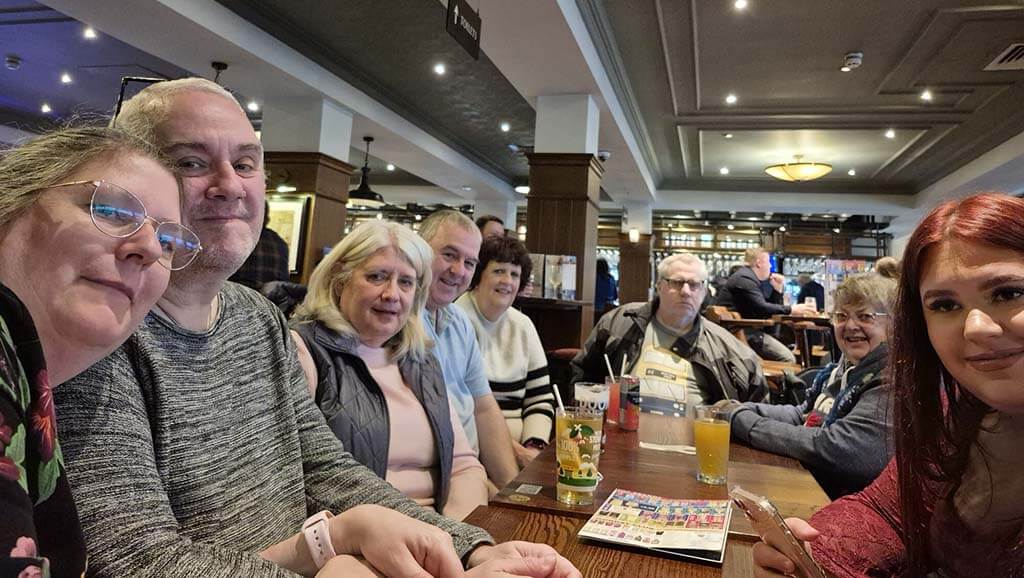
By early afternoon, hunger started to win. We headed to Wetherspoons for lunch. Practical, familiar, no fuss. When you live with chronic pain, predictability can be comforting. We found a table that worked for everyone’s needs. Some of us opted for something light. Others, like me, decided that if we were going to pay for the day later in sore muscles, we might as well enjoy a proper meal. Plus it was “Curry Thursday”.
There’s something deeply ordinary about sitting in a pub having lunch. And that ordinariness felt like a victory. Chronic pain can isolate you. It can make you cancel plans so often that eventually you stop making them. Being out, together, eating, talking about everything and nothing, reminded me how important these shared experiences are.
After our meal, different little groups went their separate ways, some to wander, some to shop, some for a moment alone. Of course, by mid-afternoon I could feel the familiar heaviness creeping in. My legs were stiff. My back was tightening. The kind of fatigue that isn’t fixed by sleep began to settle. We all recognise it in ourselves and in each other. That silent agreement passed between us: it’s time to head home.
We all met up a short while later and caught the return train to Winsford. The journey back was a little quieter. Not unhappy. Just tired. The good kind of tired, mixed with the awareness that tomorrow will be tougher. I leaned back in my seat and let my body relax as much as it would.
When I finally got home, I knew I’d needed to rest for the remainder of the evening, maybe longer. That’s the trade-off. A day out often means a recovery day after. But here’s what I’ve learned: the memory lasts longer than the flare.
Visiting the Titanic Exhibition wasn’t just about history. It was about proving to ourselves that chronic pain doesn’t get the final say. It may shape how we travel, how we move, how long we stay. It may demand ramps, lifts, and careful pacing. But it doesn’t erase our curiosity. It doesn’t cancel our amazing friendships.
Thrive Cheshire gave me more than a day in Liverpool. It gave me reassurance that I can still be part of things. That with the right support, thoughtful planning, and a bit of stubborn determination, I can step outside the narrow boundaries pain tries to set.
And sometimes, that’s enough.